Tuesday, August 17, 2010
Review: The Suburbs

Monday, August 16, 2010
Why Does Travie McCoy Want to Be a Billionaire?
So, after hearing the title of Travie McCoy’s “Billionaire”—a single from his new album Lazarus, which debuts June 8—a sigh or two would not be out of order.
Indeed, at first, the lyrics don’t seem to deviate from the norm. McCoy, like his fellow rappers, only wants fame and fortune:
But “Billionaire,” surprisingly, isn’t merely another glossily superficial litany of wealth or women (ahem, Lil Wayne); rather, it eschews the money-women-sex banalities in an unlikely meditation on munificence. What? Generosity? But that’s anathema to rappers!
It’s true. McCoy himself tells MTV that the song, which has a laid-back slowness reminiscent of anything by Jack Johnson, endeavors to “open up the question: if you were in a position to do something with a decent chunk of money, what would you do?"
As for the singer himself?
And get this:
Well, kind of. The whole song is a proposition—notice that “I would…” and “I probably” qualify each of his brazenly idealistic dreams. And, sure, it’s also a self-serving magnanimity—a wave of satisfaction comes over him as he says, You can call me Travie Claus minus the ho-ho—but McCoy’s message is still a massive improvement over Lil Wayne’s lame sexual innuendos.
The song’s music video, according to McCoy, comprises “vignettes where unfortunate things happen to people and I happen to have the anecdotes for their particular misfortune. If you listen to the lyrics…a lot of it has to do with helping people out, a lot of selfless things. Overall the vibe is real summertime, but there’s also a positive message.”
On the track, McCoy is joined by Bruno Mars, who departs from the traditional rap fare exemplified on his recent hit “Nothing on You” to provide an sonorous melody for this uplifting beach ballad. It’s a song with a simple guitar chord and drum beat—which favorably compares to the auto-tuned-to-death nature of an increasing number of pop and rap songs. It’s a perky song of human imperfection, even in the best of us—he avariciously wants to “buy everything” despite his philanthropic motivation. And, set in an economy barely dragging itself out a recession, it’s a song of creating dreams, outlandish dreams we will never realize, dreams to keep us going, the Aston Martin picture on my teacher’s wall.
Mars delivers the last lines, I wanna be a billionaire/so fuckin' bad, with a delightful resignation, ones suffused with a lush languor and an uncanny genuineness—so much so that the clean version (sans f-word) seems bowdlerized, seems false. Even budding rap stars will never have billions, but McCoy and Mars know this. As the song ends, the singers smile wide in acknowledgment of the blissful impossibility of their supposed goal—but every time I close my eyes…
Friday, August 13, 2010
Review: Perfume Genius on Learning
With each technological innovation, there seems to be a downside to match every advantage. This trend may be especially true when it comes to the music industry: though new methods of production and distribution give a greater number of people access to a greater number of artists, there is real concern that with more quantity comes less quality. But while the path has been paved for the mediocre artist, it has also been made easier for the unassuming yet wonderfully talented craftsman, the kind of musician who answers to an internal compulsion to create, rather than any desire to make it big. Seattle-bred Mike Hadreas, alias Perfume Genius, is definitely among the latter.
His debut album, Learning, released this past June, is exquisite and intimate, with sparse, spectral piano arrangements and echo-laden vocals that prove to be hauntingly compelling. Hadreas' delicate handle of piano keys is reminiscent of Sam Beam's loving hold on his guitar; and the softness of his voice shares some of Sufjan Stevens' magic. And just like these two accomplished musicians, Perfume Genius crafts incantatory, poetic lyrics that are sure to stay with you long after the speakers have fallen silent.
The record is deeply melancholic, and lingers on moments of great sadness or solitude. "Mr. Petersen" artfully draws listeners in on the details of a teacher-student relationship before unexpectedly veering toward the tragic: "He made me a tape of Joy Division/ he told me there was a part of him missing / When I was sixteen / He jumped off a building." The suddenness of the eruption of tragedy is brutal, granted. But it is honest, and it is true.
That taste for content that is real and raw finds its formal reflection in Mike Hadreas' choice of recording locales - his mother's house, on her piano. According to him, you can hear her dogs running around on some of the songs. It is this earnestness, this lo-fi intimacy, that makes Learning so captivating. Of the set of songs, Hadreas writes: "I truly intended to show them to my friends and leave it at that. But I didn't - and left all the music the same even though it's sort of a tricky feeling. I am just a hippie, that's all. I have faith that I really fucking meant it, that if I go back and mess with them I'll lose that."
So here's to Perfume Genius and his willingness to let us in on an album that is somewhat naked, despite any "tricky feelings" he might have had. Learning is marked with a sense of open-heartedness that is truly exceptional. This genuineness, coupled with the acute beauty present in every crevice of every song, transcends the melancholy, ultimately offering a cathartic, uplifting musical experience. Learning makes for an extraordinary listen, shimmering with authenticity and hinting to the enduring good health of the music industry.
Melany's grade: A
Monday, August 2, 2010
Sparkly Night Of The Soul
Like a typical suburban family’s home, Dark Night of the Soul is a collaboration on multiple levels. First off, (the late) indie ubermensch Mark Linkous lays down track after track of expertly chiseled musicianship for pro producer Danger Mouse (of Gnarls Barkley fame) to nail home with his ultra-sensitive microphones. Then, a star-studded cast of frontmen and -women that makes indie palms worldwide palpitate provides vocals and some degree of artistic vision. Like Mexican food, the result is that each variation of the above has its own flavor even though the fundamental ingredients are eerily similar. Despite cameos from stars ranging from the Strokes’ Julian Casablancas to Iggy Pop, the album’s focal point remains the canvas laid down and smoothed out by Linkous and Mouse. Fashioning a standalone instrument out of the art of production, Mouse is at his finest. And Linkous’s expert craftsmanship is brilliant – that is to say, nothing short of his status quo.
Linkous was best known for his band Sparklehorse. His band’s discography is defined by the delicate boundary between (and sometimes blurring of) gloom and beauty. Linkous’s music had a fragile magnificence that was unparalleled. In light of his suicide in March, the fragility has become all too apparent. But Dark Night of the Soul remains a beautiful piece of artwork that elicits all the right emotions at all the right times.
Saturday, July 31, 2010
(500) Days of Weezy
Almost a year after the critically-acclaimed, oh-so-cute movie (500) Days of Summer, producer My Sick Uncle has released a mash-up album called 500 Days of Weezy. This album is an odd project, taking samples from the soundtrack of the aforementioned movie, some simple beats, rhymes from Lil' Wayne (Weezy) tracks, and snippets of interviews to create a strangely enjoyable album.
The album, overall, is not fantastic. It's no surprise that many of Lil' Wayne's songs are not, shall we say, happy and light. So I was not entirely surprised when songs like "Lollipop Dreams"—in which "Lollipop" gets mixed with "You Make My Dreams Come True"—didn't sound quite right. I'm not sure Hall & Oates could have conceived anything like it, or, for that matter, would have wanted to. The song sounds like a good idea at first, but the tone of Weezy's rhyming doesn't hold up when sped up to match the melody.
Wednesday, July 28, 2010
Dark Is What They Aim For: Tired Pony's Moody Debut
Band names fall into hundreds of different categories, from pop culture references (Au Revoir Simone) to names created just to please the ear (Mates of State). In the case of indie super-group Tired Pony, the name stems from the sound, which in this case is the dominating mood of the music. The image conjured by the name is one of an overworked, overburdened animal, sides bruised by the scores of impatient children it has balanced on its back. And the set of songs it refers to is one marked by a comparable weariness, a kind of premature ageing, a sudden and insisting exhaustion.
Anyone who has heard Gary Lightbody live knows that he has got some serious pipes. So, the prospect of the Irishmen's voice placed in a new context is something to get excited about, especially because that new context includes members of Belle & Sebastian and R.E.M. But Tired Pony doesn't deliver any dramatic changes, with melodies and rhythmic patterns often reminiscent of Lightbody's work as Snow Patrol's lead singer. Their innovation is the addition of bluegrass instrumentation - mandolins and dobros, banjos and fiddles. The movement from Snow Patrol to Tired Pony is still a lateral one for Lightbody, particularly when it comes to his songwriting. Fans of his work will recognize the "lovers in a storm" imagery in album opener "Northwestern Skies" from A Hundred Million Suns' "Lightning Strike," explored in fairly similar ways.
The Place We Ran From, released this month, disappoints in that it seems to satisfy an emotional impulse more so than a creative one. Weariness is not uncommon in the musical world; the constant traveling and pressure of being under observation tend to foster that kind of exhaustion. But ideally, the music should transcend that restlessness, that unhappiness, by operating on a creative level. It could offer some sort of redemption, an exit strategy. This is not the case for Tired Pony, who often seem to let the emotions drive (rather than simply inspire) their music. Though the songs do arrive to some sort of cathartic height every so often, the builds are too slow and we may find ourselves waiting through the first three minutes of "Get On The Road" to get to the last minute and a half. The Place We Ran From can feel somewhat like it's indulging the weariness, like it glamorizes the gloom.
Of course, there are some high points to the album that make it worthwhile, and worth the wait for those of you who are stateside (US release is set for September 28th). When the album does swell to the aforementioned, much anticipated cathartic heights, it really is quite good. All in all though, it is time for Lightbody to move out of his comfort zone of moody musicality.
Melany's grade: C+
-Melany
Sunday, July 25, 2010
Review: "Lights" and "Barricade" by Interpol
Interpol has had a rough summer. First, most of their opening dates for U2 were cancelled because of Bono’s back surgery. Then Carlos D, their bassist and most iconic bandmate, left to pursue “new goals.” Without him, the band was rendered largely faceless to many fans. Even with his move from militant chic to more relaxed, normal dress, he remained an aesthetic center of the band, the one who defined what Interpol is all about. Fortunately for us, he recorded the upcoming album with the band, even if he’s not touring with them.
For those of you who aren’t familiar, Interpol was at the helm of the post-punk revival that took over the independent music scene a year or two after the garage rock style of the Strokes canonized indie rock with their album Is This It in 2001. Interpol’s album Turn On the Bright Lights, released in 2002, drew infinite comparisons to Joy Division, often seen as the one band that defined post-punk: sharp, angular basslines; monotonous vocals; sparse, often amelodic guitars; and tight, straightforward drumming. All this was hip in the late 70s and early 80s, but had largely faded out of the mainstream by the late 80s. Interpol brought this style back, and with that first album helped ensconce the post-punk sound as a core for much of the decade’s indie rock bands.
It’s been a long 8 years since then, but Interpol has managed to stay afloat, unlike so many of their early-2000s peers. Their lead single "Barricade" from their upcoming self-titled album was leaked onto the internet within the past week, and it’s a welcome sonic shift for Interpol. Their previous album, Our Love to Admire, was an unfortunate drift into unfamiliar territory for the band. From the look of this single, they’ve returned to their strengths.
The throbbing bass is what keeps "Barricade" from falling into the trap of their previous album, Our Love to Admire, which was largely composed of aimlessly plodding tracks of indeterminate structure. Carlos D keeps things on point here, and his perfect interplay with Sam Fogarino’s drums keeps Daniel Kessler (guitar) and Paul Banks (vocals/guitar) from getting carried away with their more ambient leanings. They keep the reverb to a minimum, and maintain their simple chordal strumming underneath everything. It all constitutes a move back to the concise format of their earlier songs. They could still afford to cut from the second half and make the chorus more distinctive, but "Barricade" is a lot better than anything they’ve done in the past three years.
What’s even better is that they’ve managed to distill the strongest elements from Our Love to Admire into a listenable, engaging form for this album. Their other single, "Lights", is a more controlled, focused take on the atmospheric facet of their style that took over Our Love to its detriment. This song actually goes somewhere. Paul Banks appears to have brought in some of the styling from his solo album and synthesized strong motifs and riffs into these more spacious songs. Would I still listen to "Lights" at almost any point, like I would with anything on Turn On the Bright Lights? Probably not. You have to be in the mood for it. It isn’t something infectious enough to rival their older material. It definitely does not need to be as long as it is (5:38), and it only gets really moving after four minutes. The whole gaining-momentum-to-a-sonic-climax thing isn’t one that they do too well, but they’re getting (marginally) better at it.
Interpol made the future difficult for themselves when they released their first album. Aside from being an amazing, game-changing piece of work, it restricted their aural palette to the barest of bones. The whole album was so strict in its instrumental and structural parameters that it left Interpol little room to evolve while staying faithful to their sound. Their second album was a slight misstep, their third a much larger one, but it seems as if their fourth album will mark a return to a more comprehensible, coherent evolution from Turn On the Bright Lights. We’ll have to wait until September 7 to hear in full, but based on these two tracks, I’m optimistic.
Juan Carlos’ rating:
Barricade: B+
Lights: B (but an A for effort and improvement)
-Juan Carlos
Barricade:
Lights:
Saturday, July 24, 2010
Nerdstalgia: Darren Criss at The Living Room

My childhood officially ended in the summer of 2007-- the limbo summer between the carefree days of high school, and well, Penn, but more importantly, the last Harry Potter summer. Since then, I have always tried to find ways to recreate my childhood, a tendency that Darren Criss calls “nerdstalgia.” No one does it better than he does; if you go to his YouTube channel, you’ll find a series of acoustic Disney covers. And let’s not forget his claim to fame — he stars as Harry Potter in “A Very Potter Musical,” a play he helped write and produce with his friends at the University of Michigan and which became an Internet phenomenon last summer. The musical lovingly and, might I add, hilariously spoofs the Harry Potter saga, featuring a bromance between Voldemort and Quirrel, a flamboyant Dumbledore with a poster of Zac Efron in his office, and, as promised by the opening number, a “totally awesome” soundtrack. Criss and his friends, who call themselves Team StarKid, released the much-anticipated “A Very Potter Sequel” on YouTube last week.
Two weeks ago, I went to see Criss’ free show at The Living Room in New York City, and I left thinking that it was a show I would definitely be willing to pay for the next time around. Criss owned the stage with easy charisma that perfectly suited the intimate and casual atmosphere of the venue. Though he played a short set of only ten or twelve songs, he performed each song with energy and passion. His lone acoustic guitar never sounded bare and more than filled the small room and his piano numbers were equally resonant.
After the show, I spoke briefly to Criss. With the best intentions to communicate how much I enjoyed the show, I stupidly said something along the lines of “I enjoyed that more than I expected to.” Darren, if you’re reading this, I meant that in the best possible way. Not being too familiar with Criss’ repertoire, I went to the show hoping to hear a song or two from AVPM. Criss did not disappoint on this count. Along with a fervent performance of “Not Alone,” a favorite from the musical, he gave the audience a preview of the upcoming sequel, an immediately catchy song he prefaced with, “This song is supposed to be sung by a girl,” before crooning out the lyrics “I’m the coolest girl in the world!” But even Criss’ personal acoustic music was a pleasure. “I Still Think,” probably his strongest song, was full of hooks and clever melodies, and “Human,” which Criss wrote when he was fifteen and admittedly sounds like it, was nevertheless endearing. Criss ended his show with very subtle rendition of “A Whole New World.”
His ability to combine playfulness and maturity is Criss’ unique talent, one that definitely shone through in his performance.
You can check out “A Very Potter Musical” (and soon the sequel) on YouTube, and you can also find Criss’ very musically talented brother in the band Freelance Whales.
-Mary
Friday, July 23, 2010
Nothing to Be Desired
Ok, so maybe they’re a little categorizable. Perhaps they’re at the heretofore undefined midpoint between Bourne Identity soundtracks and Sigur Ros. And one certainly wouldn’t be ostracized for saying they’re an airier version of M83. Regardless, they’re new, different, and (above all) good.
At worst, Disconnect From Desire, their latest album, is a collection of songs that blend together because everything sounds the same. But at best, it’s the optimal relaxing background music (or perhaps foreground music, depending on the situation) for bed-lying, car-driving, and/or existential window-looking. This music is beyond chill – more than atmospheric. It’s stratospheric. Exospheric even. Up here, you may forget why any band even chooses to have a guitar track in their songs.
School of Seven Bells is vocal-centric, so the use of anything other than voices is extremely limited. There’s a bassline, perhaps a synth, and not much else. Employing front-twins’ Alejandra and Claudia Deheza’s celestial vocal chords as the primary means of melody ends up being a whole lot more practical than it is artsy – which is a surprisingly difficult balance to tip in one’s favor. Their voices on tracks like “Windstorm” will blow you away, if not for sheer awesomeness, then at least for pure novelty. Disconnect from Desire may not change your life, but it will open your ears to new possibilities.
Joe's Grade: B
-Joe
Wednesday, July 21, 2010
Lilith Returns: San Fran Version

Fear God. Trust Jesus. Repent or parish. Just some low-key signs that protestors held as I walked into the Shoreline Amphitheatre in San Fran, where the Lilith Fair revival tour landed last month. For those unfamiliar with Lilith, it’s a concert tour founded by Sarah McLachlan in 1997 to honor female musicians and a portion of its proceeds are donated to female-oriented causes. Lilith ran for a two-year stint until 1999, during which it raised $10M for women’s charities in North America. It’s little wonder, then, that the megaphone-bearing bible-readers showed up to denounce its revival in the gay capital of America – the event screamed “Lesbians, come hither!”, which they did. Thousands of tattooed couples flocked to the outdoor event, picnic baskets in hand, ready for some good lady rock after a 12-year Lilith hiatus.
Musicians performed on three stages from all afternoon until almost midnight. On the main stage: Colbie Caillat, The Bangles, Miranda Lambert, Heart, and finally, the bearer of the Fair, Sarah McLachlan. On the less gargantuan stages: A Fine Frenzy, The Submarines, Susan Justice, Kitten, Ann Atomic and Terra Naomi.
Main stage highlights for me included Sarah, whose throaty voice used to blare from my older sister’s room during her broody, high school phase, and 70s rock band Heart. Lead vocalist Ann Wilson is larger than she once was, but she’s just as fierce. (I’m almost 40 years her junior and I felt my eardrums going numb during her performance). When she sang Alone (revived lately by Glee and So You Think You Can Dance) from their ’87 album Bad Animals, I got teary-eyed. Both Heart and The Bangles plugged their new albums, but I’m pretty sure people were just craving more nostalgia.
Less thrilling was Miranda Lambert, a Texan country babe who called herself a “redneck” and sang a ditty about moving closer to a place where she could buy beer. “Let me warn you, San Fran,” she said to her fans, “I’m damn good with a shotgun.” Maybe the liberal ladies in the audience were too buzzed on overpriced beer to care, but I seriously thought she was going to get stoned, and not in the good, hippie way.
A Fine Frenzy’s Alison Sudol stood out among the second group. She lulled and energized all in the same quick set, singing pain ballads like Almost Lover and Silent War, but also beating her tambourine to newer, summery tunes that before long had people up off their beach towels. “What a magnificent day, isn’t it?” she said, charmingly. Sudol paired her long, fire-engine hair with an azure mini-frock and dark red boots, so I couldn’t decide whether she looked more like a superhero or the biblical demon herself. Either way, the 25-year-old vixen didn't seem human.
If Lilith Fair is about female empowerment, then it worked. I left having witnessed not only an array of talented artists, but unprecedented courtesy from festival-goers, who begged pardon as they crawled over one another, and picked up trash when others forgot. I wonder if I’d see the same thing at a Goliath Fair.
- Daniella
Review: Thank Me Later
Like many hip hop fans, I’ve had Drake’s debut album, Thank Me Later, on almost constant rotation over the past month. I’m still not 100% sure what makes the album so infectious, but it’s managed to hold my interest far better than any other release over the past six months.
I think a large part of it is due to the work of his producer, Noah “40” Shebib. 40 has helped to create a unique sound for Drake, one that sets him apart from the rest of the hip hop field today. It’s as distinct as what RZA did for Wu-Tang and DJ Premier for Gang Starr; there’s really no one else on the scene who uses comparable beats. It’s a mix of atmospheric synths (“Shut It Down”), chopped string runs (“Thank Me Now”), bass-heavy toms (“Light Up”), and even some glitchy electronica elements (“Show Me a Good Time”), all overlaid with Drake’s nasal, auto-tuned sneer.
Some credit also has to be given to Boi-1da, the producer of Drake’s #1 single, “Over.” It’s the same guy who did “Best I Ever Had,” that ubiquitous hit from last summer. He's got an amazing talent for incorporating schmaltzy 70s funk pop orchestral arrangements into his beats, and he does it better than even Kanye. The plucky bass and whining violins of the chorus pull away from the snappy hand claps and piercing snare of the verses to make a beautifully evolving collage of contrasts under Drake’s vicious flow on the album. There’s not much that hasn’t already been said by other reviewers about Drake’s rhymes on this LP; his introspection and reflection on his sudden fame are a fascinating turn on the common tropes of hip hop. But other than that, there isn’t a lot of compelling content in what he’s saying. The real artistry is in the music on this album. It makes Thank Me Later an album in the truest sense of the word, one that can be listened to from beginning to end. Drake might be good, but on this effort, it’s the producers we should thank.
Juan Carlos' Grade: A-
-Juan Carlos
Tuesday, July 20, 2010
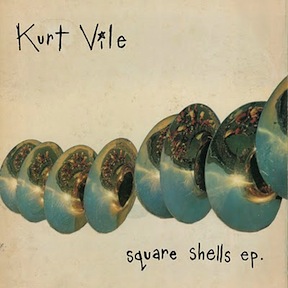
Philly Local: Kurt Vile and his "Square Shells"
In this digital age, some have predicted the end of the album as the prevailing medium of musical expression. But Kurt Vile's latest work is proof that the spirit of the album - a thoughtfully sequenced whole, with a beginning and an end, a thought process brought to its conclusion - lives on, in this case vicariously through its little brother form, the EP.
Square Shells, released this past May, has all the breadth of a good album, exploring moods and genres to create something versatile and varying. Each song carries its own distinct atmosphere, ranging from the nostalgic brooding of "I Wanted Everything" to the more light-hearted "Ocean City", all of which are united by Kurt's craftsman's touch.
The EP is a lovely play on the contrasts between psychedelic and folk influences, shifting easily from drone-dominated instrumentals ("The Finder," "Invisibility: Non-Existent") to the more traditional folk-influenced, guitar-augmented vocals. Of the latter category, "I Know I Got Religion" is a stand-out. It feels like something recorded late at night in a hotel room, a moment of solitude eased by the familiarity of fingers sliding across frets.
Kurt's psych folk fusion reaches its most symbiotic form in the final track, "Hey, Now I'm Movin." The song swells to exquisite heights in the final few minutes, spinning a web of reverberated sound that will surely leave you excited about where it is he's moving to, and what kind of music will come of it.
So show some Philly pride and give this guy a listen - we'll probably be hearing a lot more from and about him soon.
Melany's grade: A
-Melany
Saturday, July 17, 2010
Tokyo Police Club's "Champ": Aging Gracefully
The best adults are the ones that have some youth on the inside. When they released their frenetic debut EP, A Lesson in Crime, Tokyo Police Club were kids. And then, on their first full-length album, Elephant Shell, they grew up too much too quickly. Now, on their most recent, Champ, released last month, they’ve aged quite gracefully, finding a happy medium between formula and freeform, adulthood and childhood, and/or energy and predictability. In short, this is the LP we’ve been waiting for ever since we first heard the painfully short 15 minutes that made up A Lesson in Crime.
One of TPC’s strong points is its unbridled energy, but this energy is best used sparingly. That’s why their LPs can’t just be lengthened versions of A Lesson in Crime. And while they proved themselves to some extent on their last album, they’ve alleviated any and all doubt that they can write slower songs: “Hands Reversed” is just as good as anything else on the album, and doesn’t feel strained at all, a sensation that can be all too common when energetic bands go for slow.
“Bambi” is a microcosm of the band’s rediscovery of its past self. In classic TPC style, this track turns revolutionarily rough sounds into rational order: it seems impossible to go from the disjointed scratches at the beginning to something that could be even remotely aurally pleasing. But they pull it off anyway. On “Bambi,” the band goes back to what got them here in the first place: their trademark manic upper-fret scraping (a technique that was in notably short supply on Elephant Shell) is finally back. And while vocalist Greg Monks curiously decided not to sing on this track, it’s on the whole nice to hear his unique whine in conjunction with the chewy, nougat center that put the “buzz” in buzz-band just a couple of years ago. Due to Champ, they’re not a buzz-band anymore; they’re grown-ups, but it’s not too hard to tell that they’re still the same old kids.
Joe's grade: B+
-Joe
Friday, July 16, 2010
What I'll Be Listening To, "In The Sun"
The first rumors about the collaboration between Zooey Deschanel and M.Ward were greeted with a hesitance which, let’s face it, was justified by the poor track record for actors-turned-musicians. But Volume One, released in March 2008, was an impressive and convincing debut that received a warm welcome from even the sternest of skeptics. The pair’s second album, Volume Two, released this past March, proved to be equally impressive, with a more confident take on the sunny, retro-pop sound that makes She & Him so very irresistible.
Volume Two is playful and bright. It’s the kind of album you keep in your car but never tire of, the kind of music that plays up those beautiful summer days just as well as it dresses up the grayer ones. The lyrics are those of one disappointed but never beaten down, and always sung with the hint of a smile. Deschanel is, after all, determined to “make it better,” as she sings on the album’s ninth track. This upbeat outlook is part of what makes Volume Two an instant mood-lifter, and as such, a musical delight.
The other major strength of this sophomore album is its timelessness. She & Him have a firm appreciation for history, and their music is all the better for it. The record is full of throwbacks to older times, from the Bee Gees-inspired beat of “In The Sun” to the Orpheus-inspired lyrics of “Don’t Look Back.” But for all their historical consciousness, the pair never lose themselves; each song is distinctly their own – even the covers. They’ve struck the perfect balance between old and new, crafting a sound that feels homey and familiar, all the while remaining intriguing and quirky.
In short, I’ve pushed Volume Two to the center of my summer playlist – and strongly suggest you do the same!
-Melany